Scribo ergo sum: Who Are the Authors? Collaboration and Copyright in Inuit Printmaking
Troisième prix – Concours de blogue 2026
Yo nger Xie est étudiante en troisième année du baccalauréat en droit. Titulaire d’un baccalauréat en chimie et d’une maîtrise en histoire de l’art, elle porte un intérêt particulier aux enjeux de la propriété intellectuelle.
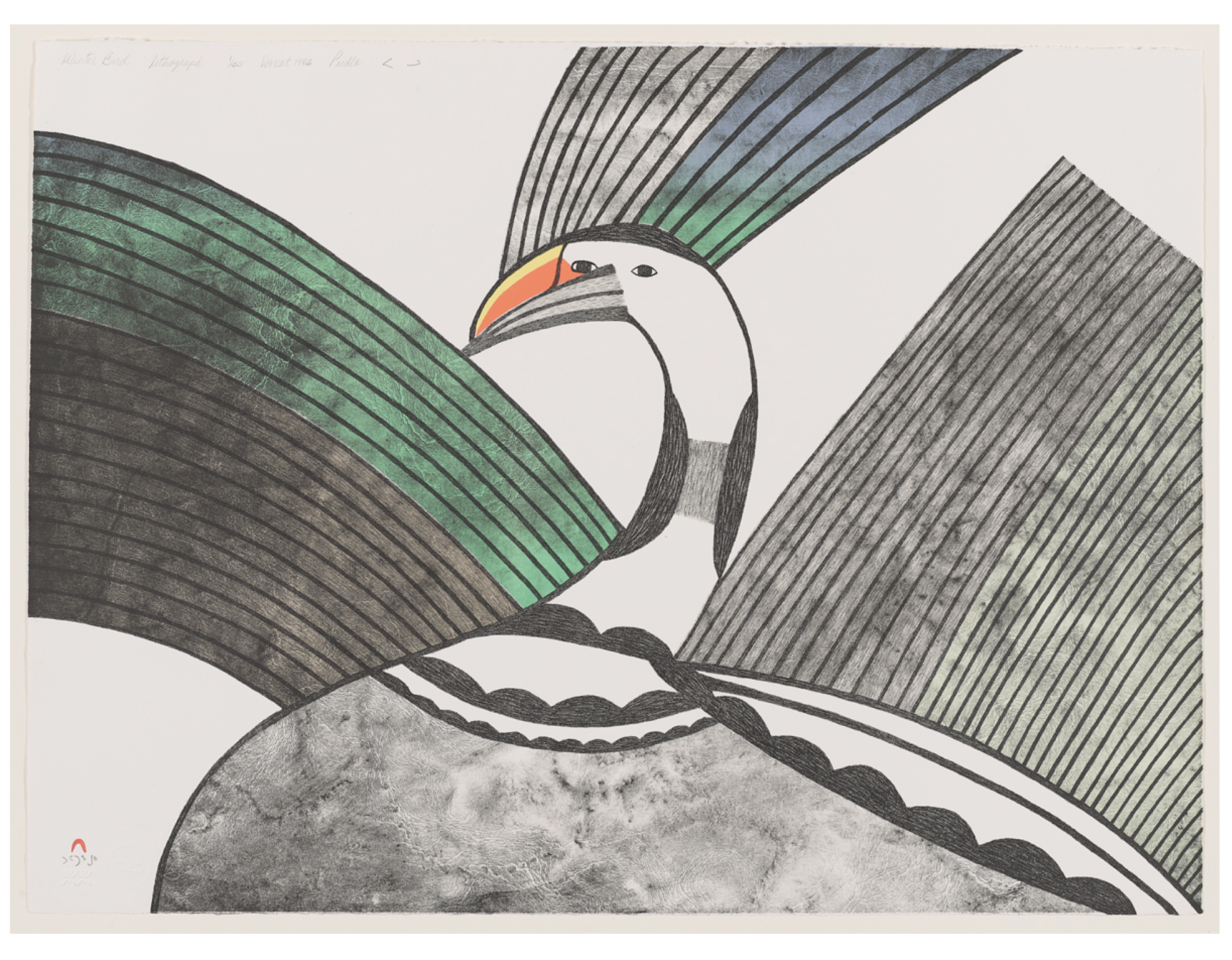
Browsing the online collection of the National Gallery of Canada, we encounter countless beautiful artworks on display, including the most recent exhibition featuring winter’s presence across diverse cultures. An Inuit print of a winter bird by Pudlo Pudlat appears at the centre of a wonderful selection of winter sceneries. Zooming onto the work, it is presented under a single author’s name. Such attribution is perhaps no surprise to the modern viewers, who are accustomed to understanding artworks as the product of an individual creative genius. Nonetheless, it is not reflective of the Inuit printmaking reality at Kinngait (Cape Dorset), where prints oftentimes result from a collaboration between graphic artists and printmakers.
This post examines the production practices at Kinngait Studios, the oldest and the longest running Inuit printmaking facility in Canada, to discover the creative, substantial contribution of the printmakers. It argues that, in many instances, printmakers should be recognized as co-authors for the prints they help to produce. The omission of their names not only erases their artistic agency but also raise questions about moral and economic rights under Canada’s Copyright Act.
Collaborative Printmaking at Kinngait Studios
Since its inception in the 1960s, the collaborative model has long defined the production practices at Kinngait Studios. Inuit graphic artists typically make their preliminary drawings at home, as access to studios or shared workspaces is limited (ROED and BARZ). These drawings are then brought to Kinngait Studios, where they are sold. Studio managers and printmakers would select drawings, isolate individual elements for translation into a print, and experiment with colour treatment (GALLPEN, GEOGHEGAN et all.). A printmaker, in the traditional understanding of the craftsmanship, is often imagined as a technician who mechanically recreate an image from one surface to another. At Kinngait, however, their creative contributions play an instrumental role in shaping the final print: they determine the most appropriate printing technique, refine the composition, develop surface textures, and test colour combinations through multiple proofs before arriving at a satisfying edition of print.
Take Winter Bird as example, the original drawing as archived by Iningat Ilagiit shows a bird rendered in felt pen and coloured predominantly in oranges, blues and greens. The print retains the same composition yet adopts drastically different tonal and textural treatments. While bright yellow-orange beak and cool green-blue feather accents remain, much of the area is shadowed in a subdued grey monochrome Tusche wash, creating an intricate texture (XIE). The drawing feels lively and warm; the print, by contrast, evokes the still, muted and cold atmosphere of a winter day. The printmaker’s decisions regarding texture and colour palette reimagine the ambiance the print aims to convey. These changes from drawing to print attests to the concretization of the printmaker’s creative agency.
Such practices continue today. Interviews with studio personnel over the past decades confirm that printmakers participate in selecting drawings for production, choosing appropriate techniques, producing numerous colour proofs, and carrying out the final edition. Despite the printmakers’ creative contributions to many prints, however, it is important to acknowledge that not every print involves the same degree of intervention from the printmaker. In some cases, the translation may be more faithful to the original idea of the graphic artist (ROED and BARZ). In others, extensive experimentation with texture and colour redefines the final result. A case-by-case analysis is therefore necessary. But where creative contribution is substantial, the printmaker should no longer be considered as merely a technician but artist in their own right.
Joint Authorship under the Copyright Act
The Copyright Act protects the expression of ideas, not the ideas themselves. This principle manifests itself in two important requirements for the protection of a work under the Copyright Act: originality and fixation. Originality requires that work to be resulted from the author’s talent and judgment. Fixation requires ideas to be fixed on a medium, physical or digital. When a printmaker surpasses the mechanical reproduction by materially shaping the expressive qualities of the image on the print, their original ideas with regards to composition, texture and colour are fixed in a tangible medium. The key question, then, is whether that contribution is sufficiently substantial to qualify them as a co-author of the artwork alongside the graphic artist. If so, printmakers would be entitled to moral rights in the work, and potentially to economic rights as well, depending on the terms of their employment and any contractual arrangements at Kinngait Studios.
The Copyright Act defines a work of joint authorship as “a work produced by the collaboration of two or more authors in which the contribution of one author is not distinct from the contribution of the other author or authors” (Copyright Act, RSC 1985, c. C-42, s. 2 [CA]). Doctrines on intellectual property further require a shared intention to create a unified work and a contribution sufficiently substantial to justify co-authorship (CARON, 2022). In the context of Inuit print production, the shared intention is clear: artists and printmakers collaborate to produce print editions. The printmaker’s contribution can be substantial, encompassing choices of technique, composition adjustment, textural addition, and colour combinations. These elements, inseparable from the original drawing, shape the visual identity of the print. Consequently, the legal framework of joint authorship becomes relevant with these criteria being met.
Moral and Economic Implications for Printmakers
As coauthor of the prints, the printmakers have moral rights to their works, including the right of authorship and the right of integrity (CA, s.14.1). Moral rights may not be assigned but may be waived; and they pass to heirs upon the author’s death (CA, s.14.2).The right of authorship is the right to be identified as the author, to use a pseudonym, or to remain anonymous (CA, s.14.1). The most direct implication for the printmakers is the right to be acknowledged alongside the graphic artist in museums or galleries’ labels, catalogues, and digital platforms such as the National Gallery of Canada’s online collection. In addition, the right of integrity translates to the right to oppose any modification or use in a context that would harm the author’s honour or reputation. In the case of a work created in collaboration, copyright subsists for the lifetime of the last surviving co-author and continues until the end of the seventieth year following that co-author’s death (CA, s.6.2). This means that recognition as a co-author can potentially prolong the duration of copyright protection for the print, as the term is calculated based on the death of the last surviving contributor rather than the graphic artist alone. Considering the potential legal implications, it is clear that the mention of the printmaker’s name next to the artwork is not simply a courteous gesture. Such attribution affirms authorship, protects the author’s reputation, and helps secure the full length of copyright protection.
With regards to economic rights, the line of inquiry requires more research. If printmakers are employees of the Kinngait Studios under a contract of service or apprenticeship, the economic rights are accorded to the employer unless any agreement stating otherwise (CA, s.13(3)).The question of economic rights would require a more thorough understanding of the employment structures at Kinngait Co-operative, and any contractual arrangement with the printmakers. These questions are worthy of further investigation, as they are intrinsically connected with broader discussions surrounding the Artist’s Resale Right. The Artist’s Resale Right would allow visual artists in Canada to receive 5% when their work is resold, which would prove especially beneficial for Indigenous and senior artists in improving their economic conditions.
Ultimately, recognizing printmakers’ right to their name does not only reattribute the credit that these artists deserve, but also refresh our understanding of Inuit printmaking. The very collaborative nature of printmaking at Kinngait Studios challenges the dominant narrative of single authorship in art and celebrates the makers’ ingenuity at every step of the art creation. Reclaiming the moral rights brings the invisible work of the printmakers to the forefront and honours the entire community of artists whose creativity gives these works their everlasting charm that continue to fascinate the contemporary art world today.
Ce contenu a été mis à jour le 14 avril 2026 à 14 h 52 min.